
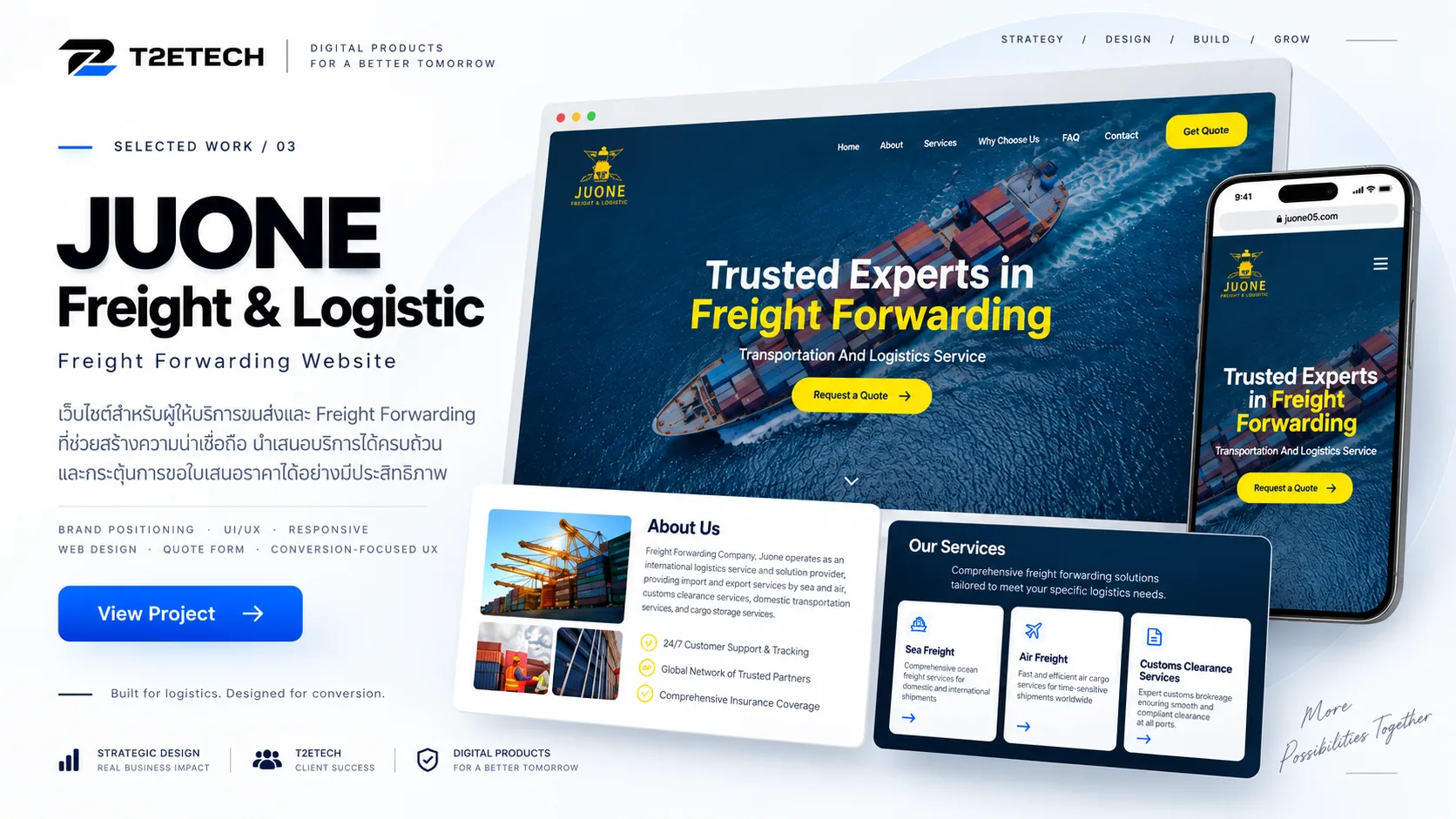
JUONE Freight & Logistic
An international freight website presenting services and essential information in a clear format with a direct quotation journey.
Explore JUONE Freight & Logistic →Explain shipping modes, actual routes and cargo requirements so customers can send a complete RFQ to the right sales team.
Freight forwarders, transport and warehouse businesses collecting B2B briefs across several service types.
Ask for information customers can provide: goods, quantity, weight and cargo-ready date. Document uploads require agreed file limits. Tracking must use authorised source-system references and data.
An illustrative scope example; inclusion is agreed for each project.
An international freight website presenting services and essential information in a clear format with a direct quotation journey.
Explore JUONE Freight & Logistic →Discuss goals, audiences and constraints to define a useful scope.
Make structure and interactions clear before development begins.
Develop the system and test critical journeys across real devices.
Launch, share documentation and use evidence to guide improvements.
Agree test cases, reviewers, account ownership and support before work. Test critical journeys with approved data before launch.
Scoped by templates, data, languages and integrations.
The proposal identifies templates, languages, content, inclusions, integrations and post-launch responsibilities before work begins.
A supported, authorised integration is required. Otherwise we can connect visitors to the existing tracking system or a clear enquiry process.
Only for actual routes with distinct, useful scope and quotation information. Repeating one page across countries adds little value.
Share the current site, example data and next steps for your team. We can identify a useful first release and future additions.
Request an estimate →